Human prehistory a main theme of the Royal Swedish Academy of Sciences school event


Mattias Jakobsson and Jenny Larsson of the Center for the Human Past, contributors to the SVT’s History of Sweden, met over 1,200 pupils at an event in Stockholm.

Photographer: Louise Sjöholm (all photos).

The schoolkids traveled back in history to where it all began. They learned about exciting new research on the origins of humans from a cross-disciplinary perspective and listened to some of Sweden’s leading researchers in genetics, linguistics and cognitive science.

The afternoon was a mixture of lectures and interactive activities, and ended with a panel discussion where students could participate and ask questions. The discussion was moderated by the science journalist Lisa Kirsebom, the editor of the publication “Science says – about human evolution”. The National Resource Center for Biology Teaching (Bioresurs) at Uppsala University was the co-organizer of the event.

Gymnasieeftermiddag om människans evolution – en dag om att förstå vårt ursprung


  • Jaison Sequeira awarded grant from the Royal Physiographic Society of Lund

    Jaison Sequeira awarded grant from the Royal Physiographic Society of Lund

    Dr. Jaison Jeevan Sequeira, Human Past SCAS Junior Fellow, has been awarded 97,000 SEK from the Nilsson-Ehle Endowments 2026 of the Royal Physiographic Society in Lund. The grant supports his project, “Deciphering the dual Steppe ancestry and linguistic stratification in Indo-Aryan populations,” which integrates high-resolution genomic analyses with historical linguistics to investigate whether Steppe-related ancestry…

  • Paleogenomics illuminates mobility and changing lifeways in Chalcolithic Anatolia

    Paleogenomics illuminates mobility and changing lifeways in Chalcolithic Anatolia

    Axel Palmér and our former Human Past SCAS Fellow, Mehmet Somel, are among the co-authors of a new paper in Cell. Congratulations to the whole team! Highlights Abstract Once labelled the “Dark Ages” of Anatolian prehistory, the Chalcolithic period (c. 6000–3000 BCE) was characterised by drastically reduced settlement densities compared with the preceding Neolithic and…

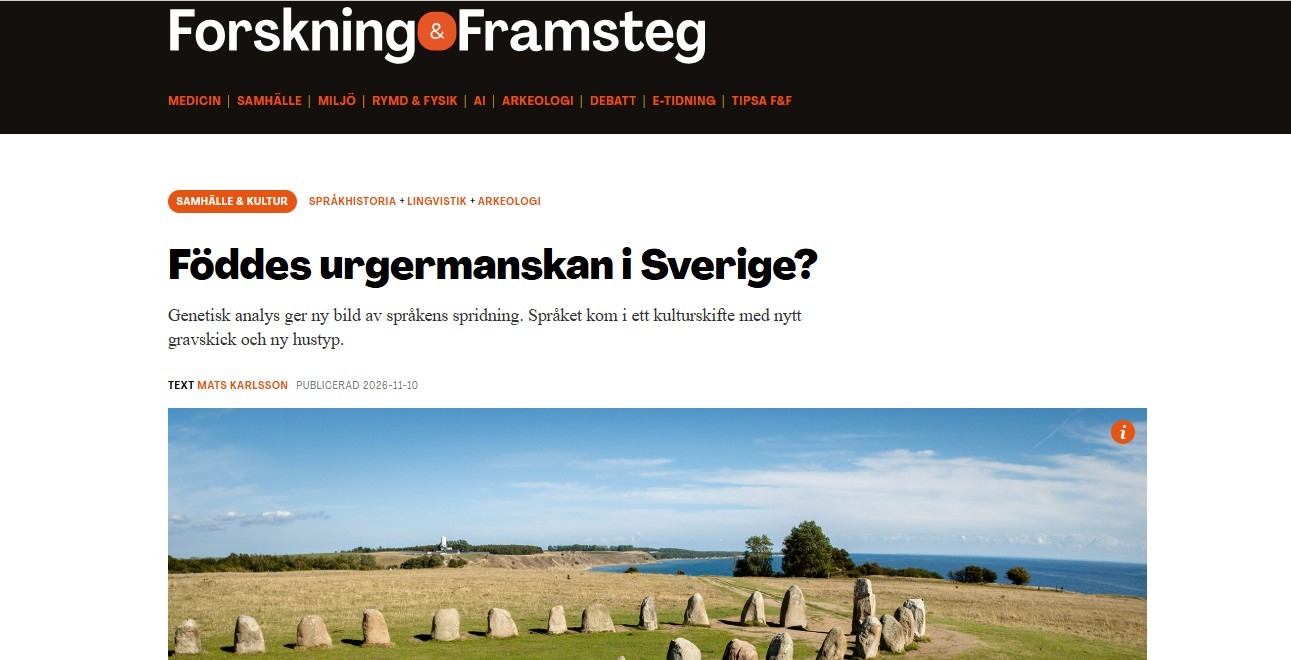
  • Did Paleogermanic originate in Sweden?

    Did Paleogermanic originate in Sweden?

    Jenny Larsson, one of the Center for the Human Past’s leaders, was approached to comment on the two recent Nature publications by McColl and others (2026) . The co-authors suggest that genetic analyses paint a new picture of how languages spread. According to them, the language arrived during a cultural shift that brought new burial…