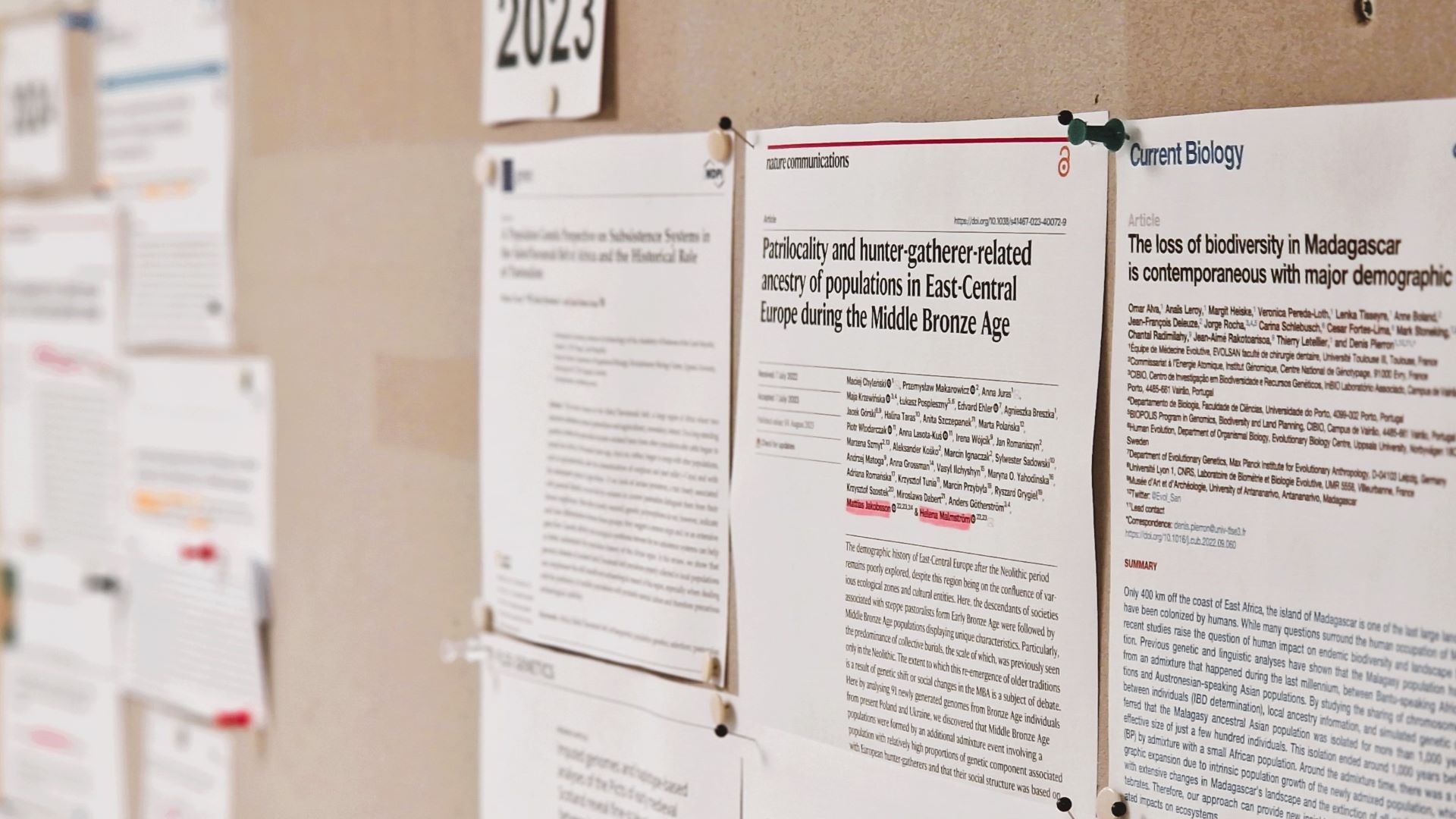
Warm congratulations to Carina Schlebusch who becomes an Uppsala University professor


“I could not have imagined that I would become a professor at Uppsala University when I came here 14 years ago as a young postdoc. It’s incredible fun. (…) it’s great to work on something that you feel passionate about.”

Carina Schlebusch is one of the Center’s for the Human Past leaders. She’s a population geneticist with particular interest in human history and Africa, partly because Carina is from Africa. In addition, African populations have the greatest genetic variation in the human family tree.

“What also interests me is the population expansions that have occurred over the last 2-12,000 years on all continents of the world. As the climate warmed, people adopted new lifestyles, started farming and developed new technologies. I want to understand the driving forces behind the groups that replaced or absorbed other populations (…). What were the interactions between local and migrant groups? And what effects did migration have on population history?”

Carina’s inaugural talk “Mapping Human History through African Genetics” takes place in Lecture Hall IX of the Uppsala University Main Building on 13th Nov at 11:00 (open to attend).
In:


  • UU researcher profile: Harald Hammarström documents languages on the verge of extinction

    UU researcher profile: Harald Hammarström documents languages on the verge of extinction

    A professor of linguistics with a Master’s in computer science and a PhD in computational linguistics, Harald goes an extra mile to document the languages that head towards extinction. “Throughout time, smaller languages have always been swallowed up by larger ones. But now, with globalisation, this is happening at an incredibly accelerated pace.” Language has…

  • Carina Schlebusch’s current research—in a nutshell

    Carina Schlebusch’s current research—in a nutshell

    Carina Schlebusch is combining archaeology, genetics and biochemistry with the aim of discovering how human genes have adapted to changing lifestyles over thousands of years. Prehistoric DNA from skeletal remains in Africa can provide answers to questions about diet, disease and survival, and perhaps even offer clues about humanity’s future health. The goal now is…

  • Meet Lydia Furness, our new postdoctoral researcher in interdisciplinary genetics

    Meet Lydia Furness, our new postdoctoral researcher in interdisciplinary genetics

    “My research background lies at the intersection of archaeology, evolutionary anthropology, and biomolecular science. I trained initially as an archaeologist at the University of Liverpool, specialising in archaeological science and early human evolution, which provided a strong foundation in archaeological practice, material analysis, and the ethical dimensions of working with human remains and cultural heritage.”…