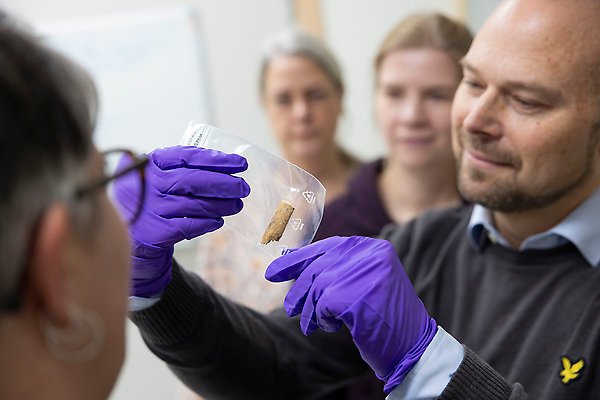


Mattias Jakobsson and Carina Schlebusch are two co-authors of the study on ancient South Africans that was just published.
Abstract
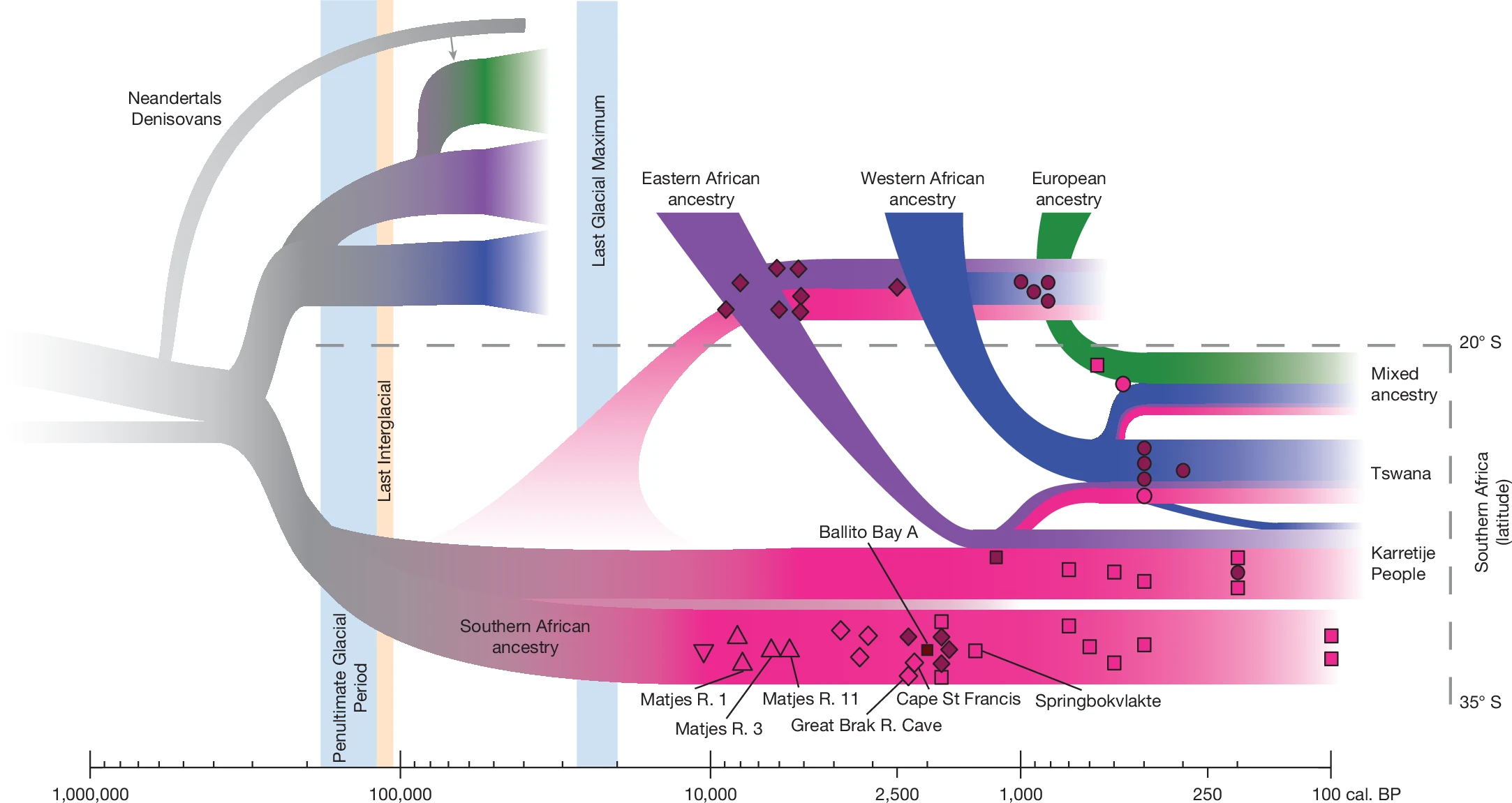
Homo sapiens evolved hundreds of thousands of years ago in Africa, later spreading across the globe, but the early evolutionary process is debated. Here we present whole-genome sequencing data for 28 ancient southern African individuals, including six individuals with 25× to 7.2× genome coverage, dated to between 10,200 and 150 calibrated years before present (cal. bp). All ancient southern Africans dated to more than 1,400 cal. bp show a genetic make-up that is outside the range of genetic variation in modern-day humans (including southern African Khoe-San people, although some retain up to 80% ancient southern African ancestry), manifesting in a large fraction of Homo sapiens-specific variants that are unique to ancient southern Africans. Homo sapiens-specific variants at amino acid-altering sites fixed for all humans—which are likely to have evolved rapidly on the Homo sapiens branch—were enriched for genes associated with kidney function. Some Homo sapiens-specific variants fixed in ancient southern Africans—which are likely to have adapted rapidly on the southern African branch—were enriched for genes associated with protection against ultraviolet light. The ancient southern Africans show little spatiotemporal stratification for 9,000 years, consistent with a large, stable Holocene population transcending archaeological phases. While southern Africa served as a long-standing geographical refugium, there is outward gene flow over 8,000 years ago; however, inward gene flow manifests only after around 1,400 years ago. The ancient genomes reported here are therefore key to the evolution of Homo sapiens, and are important for advancing our understanding of human genomic variation.
Jakobsson, M., Bernhardsson, C., McKenna, J., Hollfelder, N., Vicente, M., Edlund, H., Coutinho, A., Sjödin, P., Brink, J., Zipfel, B., Malmström, H., Lombard, M. & Schlebusch, C. (2025). Homo sapiens-specific evolution unveiled by ancient southern African genomes. Nature. https://doi.org/10.1038/s41586-025-09811-4