
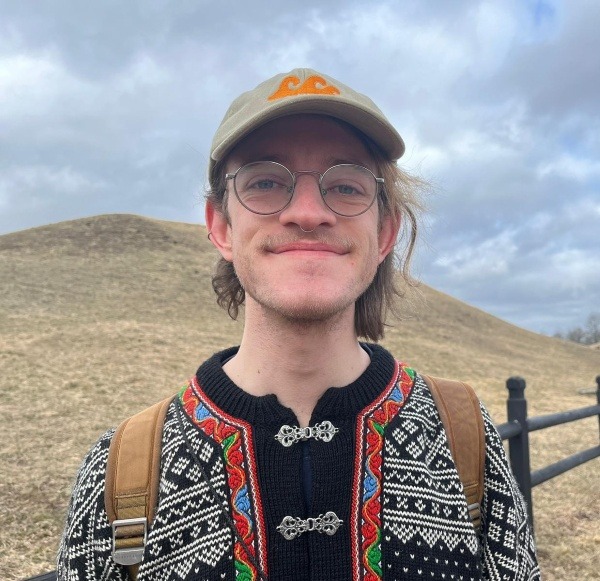
Meet Daniel Brown, our new postdoctoral researcher in interdisciplinary archaeology


Daniel Brown

“I am a multidisciplinary archaeologist with a background in archaeological science, database and collections management, and pedagogy.

My PhD project enshrined many of these interdisciplinary principles. I utilised cutting-edge archaeological science techniques, alongside varied theoretical models, to uncover relationships between people, food, and pottery in the Early and Middle Neolithic period of the Outer Hebrides of Scotland. This also involved collaborating with researchers from multiple universities, heritage institutions, and museums.”

Daniel’s proposed research aims to develop new cutting-edge methodologies to test how computer-based analytical methods and QGIS modelling can be used in conjunction with multiple large databases to answer large-scale archaeological research questions.

These novel methods will be used to shed light on the origins and spread of subsistence agriculture across Northern Europe, beginning in the Neolithic period (approximately 4000 BCE). This will be done by aggregating data from various databases hosted by the Swedigarch national infrastructure.

  • Mattias Jakobsson receives an award from the Royal Society of Arts and Sciences of Uppsala

    Mattias Jakobsson receives an award from the Royal Society of Arts and Sciences of Uppsala

    The 2026 prize for an interdisciplinary achievement of outstanding quality is awarded to Mattias Jakobsson for his distinguished research into human origins and prehistory. By linking Stone Age genomic data with archaeology and linguistics, Jakobsson has shown that there were different populations that engaged in farming, and hunting and gathering. Read more about the Royal…

  • Gut microbes that trace ancient human journeys

    Gut microbes that trace ancient human journeys

    The newest piece in Nature’s News & Views, co-authored by our PI, Carina Schlebusch and Maja Vukovikj from Human Evolution Program at Uppsala University discusses the study by Carter et al. exploring what our gut microbiomes can tell us about human population history. Humans have never travelled alone. When our ancestors spread out of Africa…

  • The unknown origins of humans on Swedish radio

    Mattias Jakobsson was featured on Swedish Radio’s morning program (Förmiddag i P1) today, 29 Sept 2026. His conversation with Nicke Nordmark, the program leader, is available at: https://www.sverigesradio.se/avsnitt/manniskans-okanda-ursprung (in Swedish). They talked about Homo Sapiens, Neanderthals, and Denisovans and their coexistence; the unknown DNA in our genes; and the possibility that humans as we know…