
The newest piece in Nature’s News & Views, co-authored by our PI, Carina Schlebusch and Maja Vukovikj from Human Evolution Program at Uppsala University discusses the study by Carter et al. exploring what our gut microbiomes can tell us about human population history.


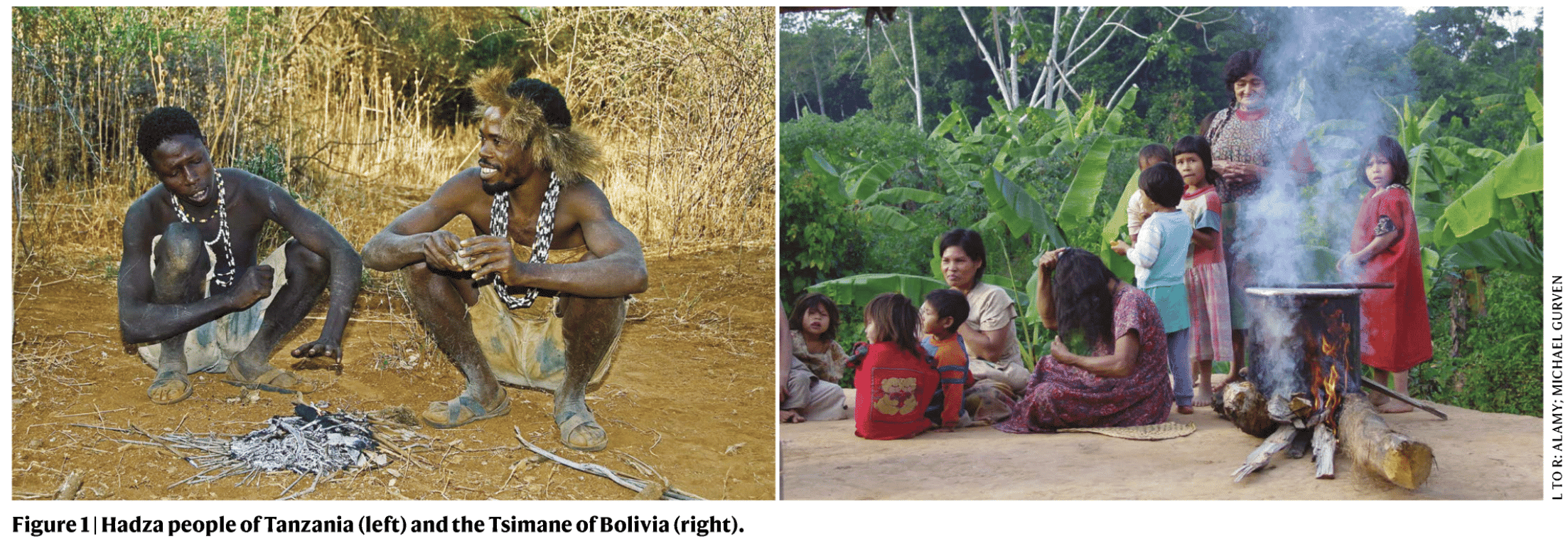
Humans have never travelled alone. When our ancestors spread out of Africa and across the other continents, they carried their microorganisms with them. Writing in Nature, Carter et al.1 compare the community of gut microbes (also known as the microbiota) from the Indigenous Hadza people of Tanzania with that of the Tsimane of Bolivia, whose populations diverged during human migrations that occurred tens of thousands of years ago. The authors report that, despite these dispersals, hundreds of microbial species are present in both groups. Furthermore, genetic differences between strains of the same microbial species in Hadza and Tsimane populations were broadly consistent with the timescale of prehistoric human migrations. Many of these shared microbes are now rare or missing in populations from industrialized regions.
Relevant reading:
Carter, M.M., Liu, Z., Olm, M.R. et al. Prehistoric global migration of vanishing gut microbes with humans. Nature (2026). https://doi.org/10.1038/s41586-026-11106-1