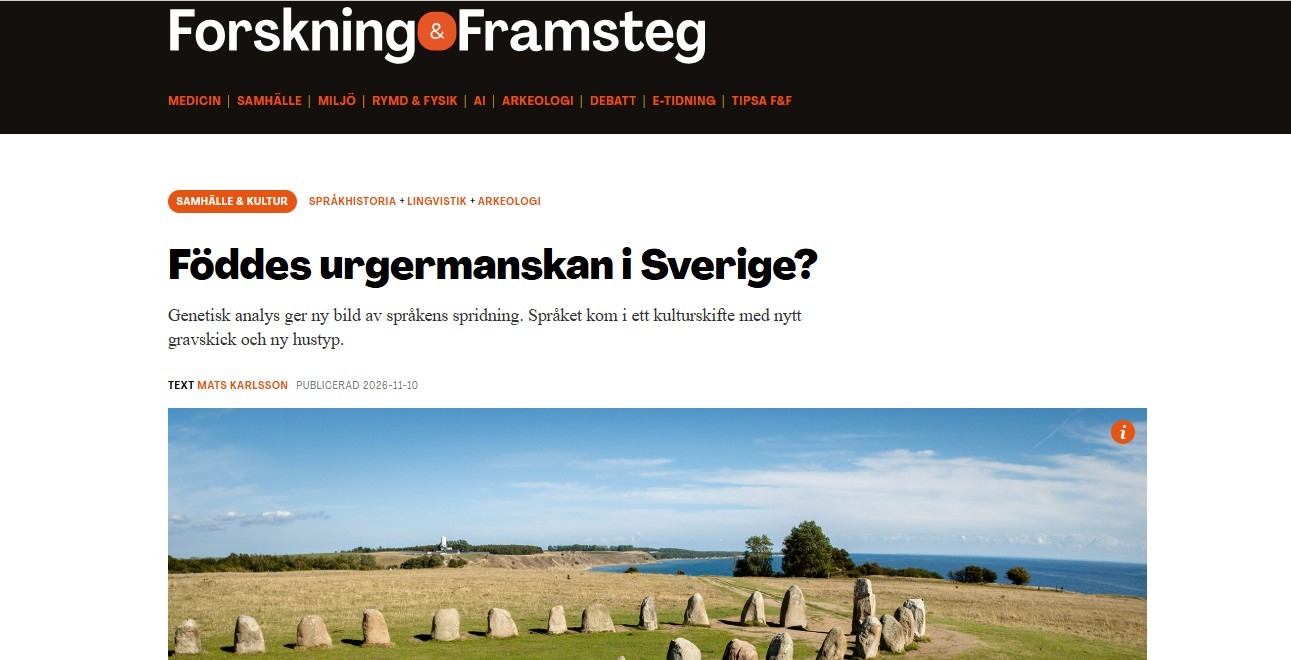
Jenny Larsson, one of the Center for the Human Past’s leaders, was approached to comment on the two recent Nature publications* by McColl and others (2026). The co-authors suggest that genetic analyses paint a new picture of how languages spread. According to them, the language arrived during a cultural shift that brought new burial customs and a new type of house.
Larsson didn’t work on this particular study. In an interview for Forskning och Framsteg, she emphasises that Proto-Germanic is difficult to comment on linguistically, but that the study is interesting.

Germanic shares certain features with the Balto-Slavic languages, even though they belong to different branches of the language tree. There is also evidence of early contact with Celtic and Uralic languages, such as Baltic Finnish and Sami. How they relate to each other in time and space is difficult to determine.
The full article (in Swedish) can be found in the latest issue of Forskning och Framsteg, FoF.se (10 Nov 2026).
*McColl, H., Kroonen, G., Moreno-Mayar, J.V. et al. Tracing the spread of Germanic languages using ancient genomics. Nature (2026). https://doi.org/10.1038/s41586-025-09064-1 and McColl, H., Kroonen, G., Pinotti, T. et al. Tracing the spread of Celtic languages using ancient genomics. Nature (2026) https://doi.org/10.1038/s41586-026-11198-9.