How genetics, linguistics and archaeology together can fill the gaps in our current knowledge about humans.


Sequencing genes from people who lived long ago and those living today has become an important piece of the puzzle in understanding early human history and how the world was populated. Through DNA analyses, we know today that modern humans had children with Neanderthals. And also with the enigmatic Denisovans who we basically only know about through their genetic makeup. Mattias Jakobsson talks with Åsa Malmberg about prehistoric humans, Denisovans, how it happened that we carry a fragment of Neanderthals in our genes today, and how we know so much about it.
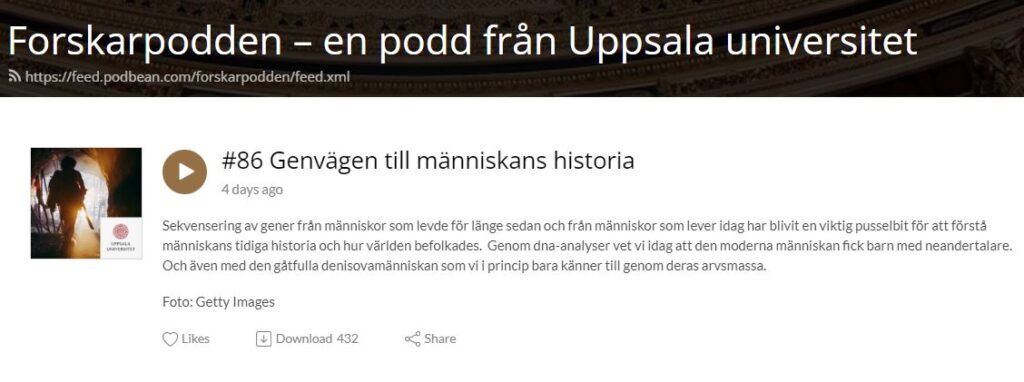
Listen to the Episode #86 in the Research podcasts series from Uppsala University (in Swedish): #86 Genvägen till människans historia
Read more (in Swedish)

Interested in more on the subject? The Philippine ethnic group Ayta Magbukon has the highest proportion of genes from our extinct relatives, the Denisovans. Their Denisovan share far exceeds that of ethnic groups in Papua New Guinea, who previously held the record. The study also provides another clue to the mystery of the Denisovans, how they interacted with the modern humans and what happened to them subsequently. In the scientists’ view, the combined findings reveal a complex, intertwined history of present-day and archaic hominins in Oceania, where distinct island populations of Denisovans interbred with modern humans in several different places and at various times.

Read the whole news article.
The study is published in the scientific journal Current Biology (Larena et al. (2021), Philippine Ayta possess the highest level of Denisovan ancestry in the world, Current Biology. DOI: 10.1016/j.cub.2021.07.022).
  • New VR grants for Mattias Jakobsson and Carina Schlebusch

    New VR grants for Mattias Jakobsson and Carina Schlebusch

    Searching for sapiens-specific evolution Mattias Jakobsson receives new funding from the Swedish Research Council (Vetenskapsrådet, VR) to “develop a statistical, machine-learning–based framework that jointly analyses genomes from archaic humans, ancient southern Africans, and present-day populations.” In the next four years, the project expects to identify genomic regions and biological pathways that evolved rapidly during the…

  • RJ funds a new program, “From Milk to Mead – Indo-European Food Culture in Prehistory”, co-led by Jenny Larsson

    RJ funds a new program, “From Milk to Mead – Indo-European Food Culture in Prehistory”, co-led by Jenny Larsson

    Riksbankens Jubileumsfond (RJ) is an independent foundation that supports research in the humanities and social sciences essential to understanding and addressing society’s current challenges, both nationally and globally. Through its funding, the foundation aims to promote basic research of the highest scientific quality. It also responds to the need for long-term, stable research funding. This…

  • Complex maternal genetic landscape in the Koṅkaṇī population of India

    Complex maternal genetic landscape in the Koṅkaṇī population of India

    Sequeira, J. J., Kumar, L., van Driem, G., Thangaraj, K., & Mustak, M. S. (2026). Complex maternal genetic landscape in the Koṅkaṇī population of India. Heredity, 1-11. DOI: https://doi.org/10.1038/s41437-026-00896-9 A new genetic study sheds light on the maternal ancestry and historical demographic dynamics of the Konkani population along the southwest coast of India. The research…