Unpacking complexities of ancient human migrations and genetic variations in HEAS Podcast series, episode 6


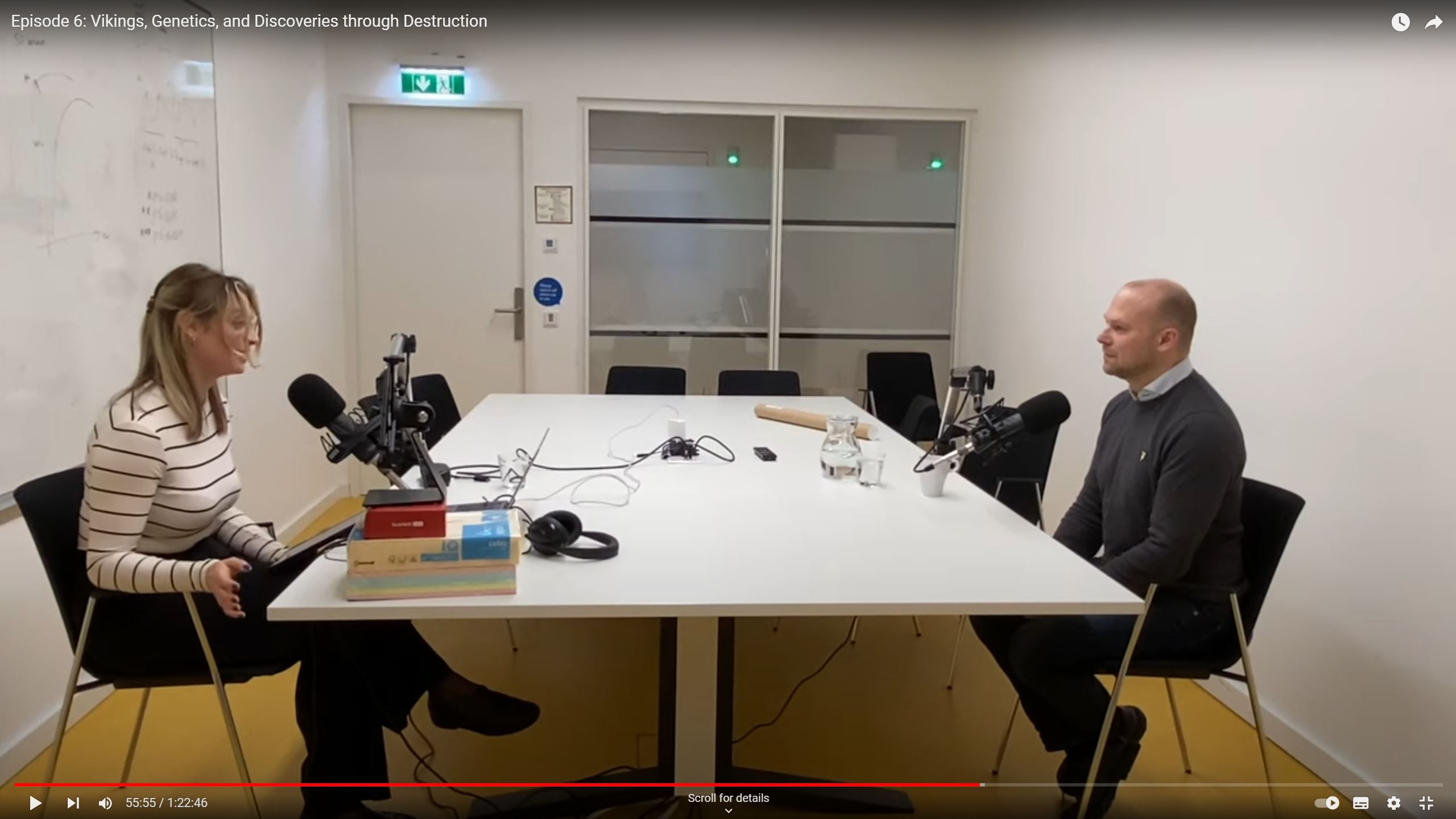
Earlier this year, Mattias Jakobsson appeared in the HAES podcast “Vikings, Genetics and Discoveries through Destruction”. The podcast series is produced by the Human Evolution and Archaeological Sciences research network at the University of Vienna, and it reaches 1,31K subscribers on YouTube. Mattias dove headlong in explaining the complex patterns of human migration in prehistoric times, and the genetic variations that help solve the migratory routes’ puzzle.

Listen to the podcast on Spotify or watch the episode 6 on YouTube (in English).


  • The unknown origins of humans on Swedish radio

    Mattias Jakobsson was featured on Swedish Radio’s morning program (Förmiddag i P1) today, 29 Sept 2026. His conversation with Nicke Nordmark, the program leader, is available at: https://www.sverigesradio.se/avsnitt/manniskans-okanda-ursprung (in Swedish). They talked about Homo Sapiens, Neanderthals, and Denisovans and their coexistence; the unknown DNA in our genes; and the possibility that humans as we know…

  • Diachronic reuse of Neolithic burial monuments by Bronze Age newcomers in Southwestern Britain

    Diachronic reuse of Neolithic burial monuments by Bronze Age newcomers in Southwestern Britain

    A new paper, co-authored by Nikola Vuković, Carolina Bernhardsson and Mattias Jakobsson, from the Human Evolution Program at Uppsala University, in close collaboration with British archaeologists, has recently been published in Scientific Reports:Vuković, N., Bernhardsson, C., Edlund, H., Delbarre, G., Smith, M., Darvill, T., … & Jakobsson, M. (2026). Diachronic reuse of Neolithic burial monuments…

  • Matte Sjölander’s STSM Experience in Utrecht 2026

    Matte Sjölander’s STSM Experience in Utrecht 2026

    In June 2026, Mattias Sjölander visited Utrecht University to host a brainstorming session on integrating subfossil insect and pollen data in future analyses. The visit, a so-called Short-Term Scientific Mission within Open Palaeoecological Data (PalaeOpen), was funded by the European Cooperation in Science and Technology (COST). During my ongoing postdoctoral project at the Center for the Human…