Ad hoc mini-seminars by CHP


We have started ad hoc mini-seminars in our new headquarters,Villa Lugnet.
The mini-seminars are by invitation only to enable in-depth discussions and exchange of knowledge across the relevant research areas.

The first mini-seminar took place 25th Sept.
Speaker: Axel Palmér, Junior Fellow, Human Past Fellowship Program (SCAS & CHP fellowships 2024-25)
Title: “Archaeolinguistic perspectives on the Proto-Indo-Iranian homeland”


  • Paleogenomics illuminates mobility and changing lifeways in Chalcolithic Anatolia

    Paleogenomics illuminates mobility and changing lifeways in Chalcolithic Anatolia

    Axel Palmér and our former Human Past SCAS Fellow, Mehmet Somel, are among the co-authors of a new paper in Cell. Congratulations to the whole team! Highlights Abstract Once labelled the “Dark Ages” of Anatolian prehistory, the Chalcolithic period (c. 6000–3000 BCE) was characterised by drastically reduced settlement densities compared with the preceding Neolithic and…

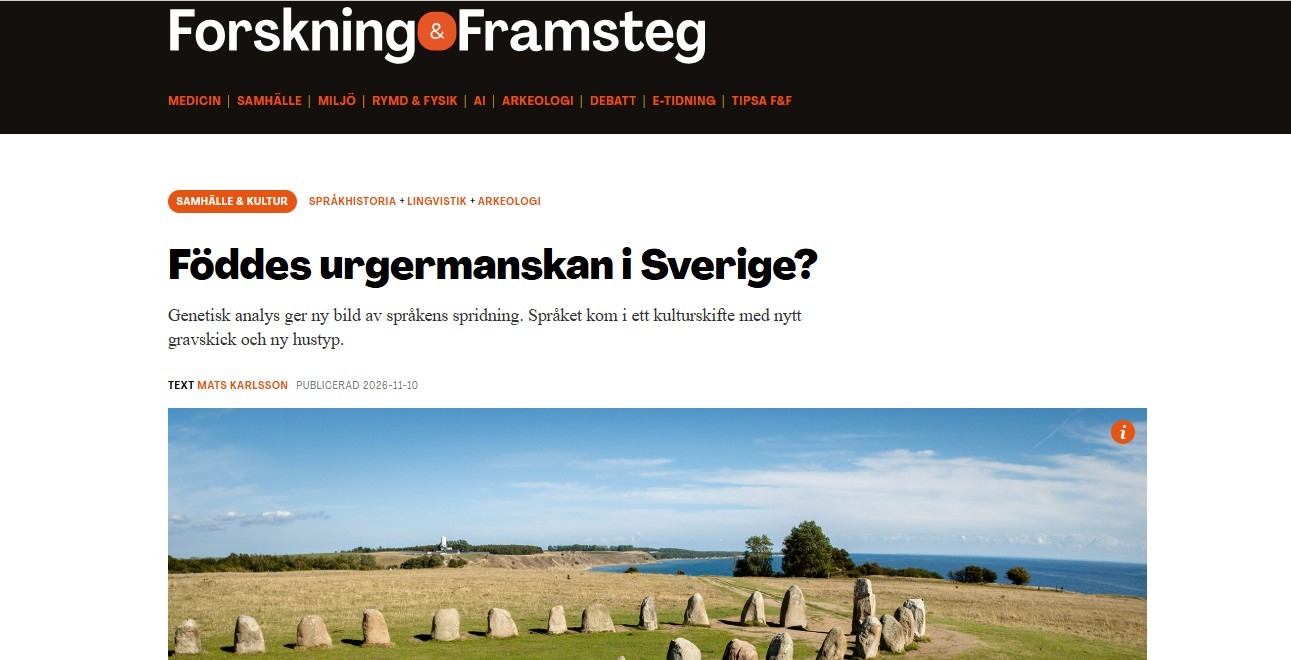
  • Did Paleogermanic originate in Sweden?

    Did Paleogermanic originate in Sweden?

    Jenny Larsson, one of the Center for the Human Past’s leaders, was approached to comment on the two recent Nature publications by McColl and others (2026) . The co-authors suggest that genetic analyses paint a new picture of how languages spread. According to them, the language arrived during a cultural shift that brought new burial…

  • New VR grants for Mattias Jakobsson and Carina Schlebusch

    New VR grants for Mattias Jakobsson and Carina Schlebusch

    Searching for sapiens-specific evolution Mattias Jakobsson receives new funding from the Swedish Research Council (Vetenskapsrådet, VR) to “develop a statistical, machine-learning–based framework that jointly analyses genomes from archaic humans, ancient southern Africans, and present-day populations.” In the next four years, the project expects to identify genomic regions and biological pathways that evolved rapidly during the…