New read alert: Population history and admixture of the Fulani people from the Sahel


The new paper by Fortes-Lima, Diallo, Janoušek, Černý, and Schlebusch (2025) was published last week in The American Journal of Human Genetics.

Photograph: Viktor Černý

Researchers have uncovered the origins and genetic diversity of the Fulani, one of Africa’s largest pastoral populations. The study reveals a complex genetic ancestry with influences from North and West Africa, shaped by historical migrations that have left a lasting impact on their genetic landscape.

The study was conducted in seven African countries from the Sahel belt in collaboration with Fulani communities and local researchers. The researchers collected biological samples and anthropological information from over 460 Fulani participants across 18 African locations.


Media Coverage


  • Paleogenomics illuminates mobility and changing lifeways in Chalcolithic Anatolia

    Paleogenomics illuminates mobility and changing lifeways in Chalcolithic Anatolia

    Axel Palmér and our former Human Past SCAS Fellow, Mehmet Somel, are among the co-authors of a new paper in Cell. Congratulations to the whole team! Highlights Abstract Once labelled the “Dark Ages” of Anatolian prehistory, the Chalcolithic period (c. 6000–3000 BCE) was characterised by drastically reduced settlement densities compared with the preceding Neolithic and…

  • Did Paleogermanic originate in Sweden?

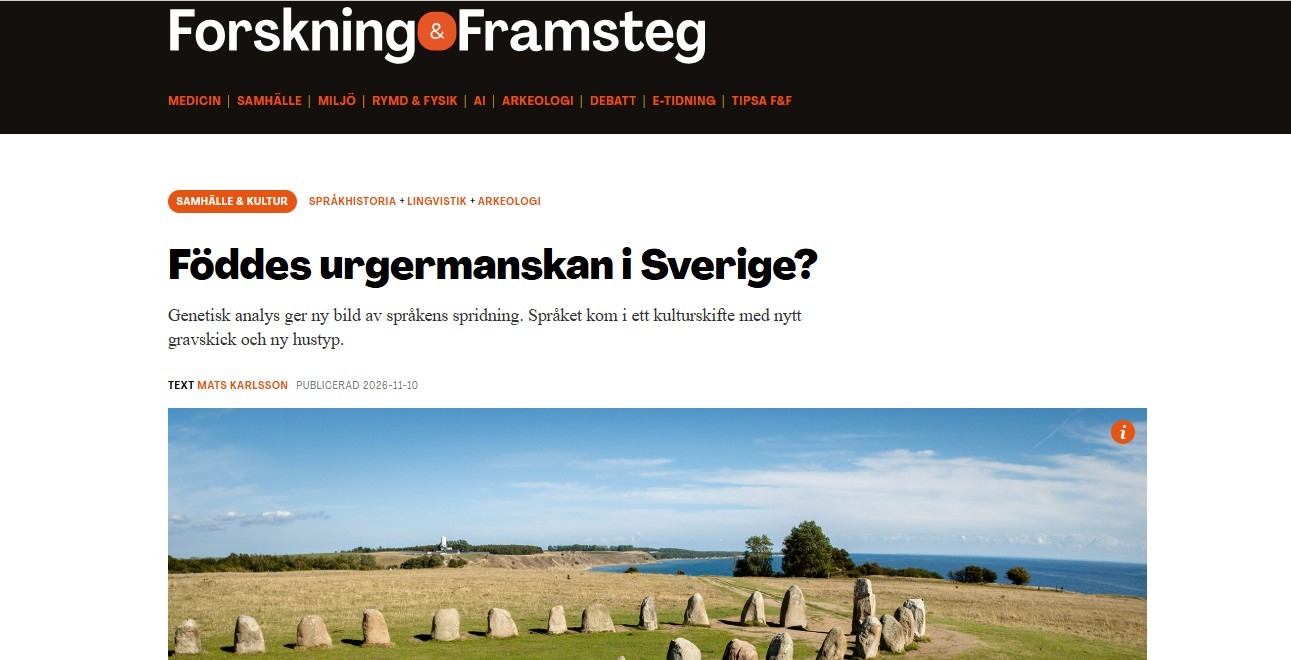
    Did Paleogermanic originate in Sweden?

    Jenny Larsson, one of the Center for the Human Past’s leaders, was approached to comment on the two recent Nature publications by McColl and others (2026) . The co-authors suggest that genetic analyses paint a new picture of how languages spread. According to them, the language arrived during a cultural shift that brought new burial…

  • New VR grants for Mattias Jakobsson and Carina Schlebusch

    New VR grants for Mattias Jakobsson and Carina Schlebusch

    Searching for sapiens-specific evolution Mattias Jakobsson receives new funding from the Swedish Research Council (Vetenskapsrådet, VR) to “develop a statistical, machine-learning–based framework that jointly analyses genomes from archaic humans, ancient southern Africans, and present-day populations.” In the next four years, the project expects to identify genomic regions and biological pathways that evolved rapidly during the…