The Royal Swedish Academy of Sciences (Kungliga Vetenskapsakademien) was founded on 2 June 1739. It is an independent, non-governmental scientific organization that takes special responsibility for promoting natural sciences and mathematics and strengthening their influence in society whilst endeavouring to promote the exchange of ideas between various disciplines.
The goals of the academy are:
- To be a forum where researchers meet across subject boundaries,
- To offer a unique environment for research,
- To provide support to younger researchers,
- To reward outstanding research efforts,
- To communicate internationally among scientists,
- To advance the case for science within society and to influence research policy priorities
- To stimulate interest in mathematics and science in school, and
- To disseminate and popularize scientific information in various forms.
Every year, the academy awards the Nobel Prizes in physics and chemistry, the Sveriges Riksbank Prize in Economic Sciences in Memory of Alfred Nobel, the Crafoord Prize, the Sjöberg Prize and several other awards. The academy maintains close relations with foreign academies, learned societies and international scientific organizations and also promotes international scientific cooperation.
The academy has elected about 1,700 Swedish and 1,200 foreign members since it was founded in 1739. Today, the academy has about 470 Swedish and 175 foreign members which are divided into ten “classes”, representing ten various scientific disciplines:
- Class for mathematics
- Class for astronomy and space science
- Class for physics
- Class for chemistry
- Class for geosciences
- Class for biosciences
- Class for medical sciences
- Class for engineering sciences
- Class for social sciences
- Class for humanities and for outstanding services to science
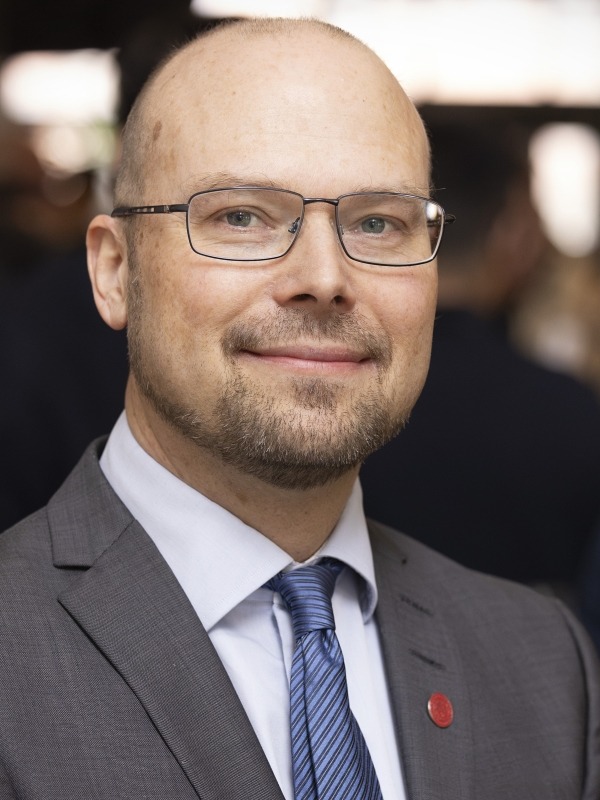
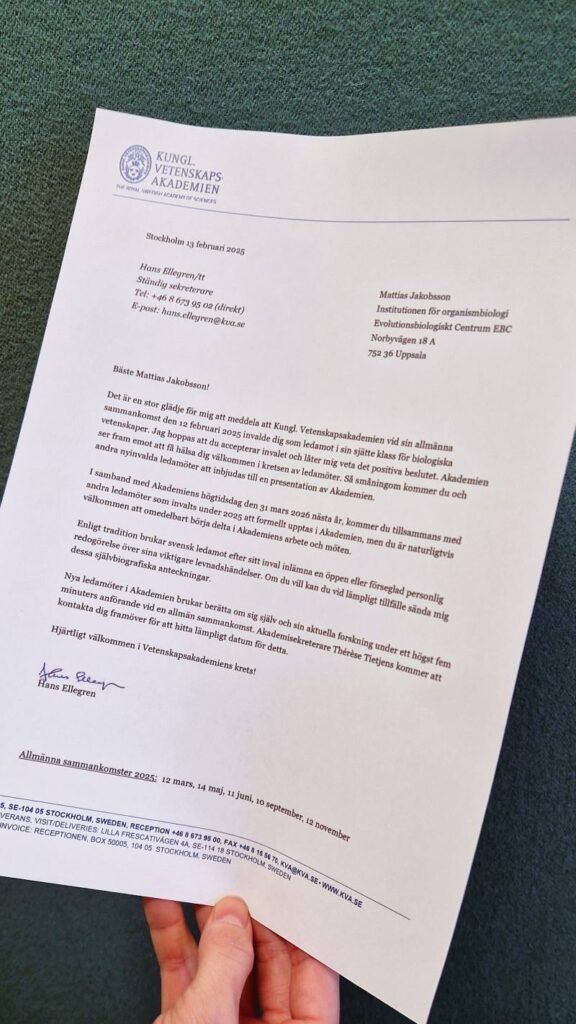
At the General Meeting on 12 February 2025, Mattias Jakobsson was elected a new Swedish member of the Academy, Class for biosciences. All the members elected in 2025 will be officially recognized as such from 31 March 2026.
Warm congratulations!