We’re excited to announce the Human Past Fellows for the academic year 2026-27. We will welcome Jaison Jeevan Sequeira as the Junior Fellow (during the whole academic year 2026-27) and Sohini Ramachandran as Senior Fellow in the spring term.
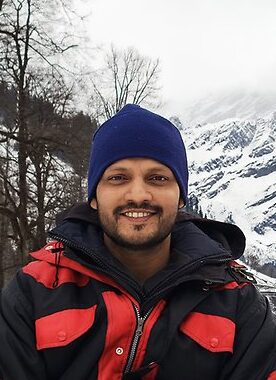
Jaison Jeevan Sequeira, PhD, Mangalore University, India
Junior Fellow 2026-27
Deciphering the dual Steppe ancestry and linguistic stratification in Indo-Aryan populations
The Indo-Aryan migration into South Asia represents one of the most consequential demographic and cultural transitions in ancient history. While genetic studies have established the broad outlines of Steppe-pastoralist contributions to South Asian populations, emerging evidence suggests this expansion may have involved distinct migratory waves with differing interactions with local populations.
This study seeks to investigate the hypothesis that two genetically distinguishable Steppe-derived groups entered South Asia at different periods, leaving distinct linguistic and demographic imprints:
– The early wave (potentially Vedic-associated) exhibiting substantial admixture with indigenous populations and strong Dravidian linguistic influence (Wave 1)
– A later wave (possibly Saka-related) maintaining higher Steppe ancestry and showing minimal Dravidian substrate (Wave 2).
By integrating cutting-edge genomic analysis with rigorous linguistic investigation, this project will provide higher resolution into how population movements shaped South Asia’s complex ethnolinguistic landscape.
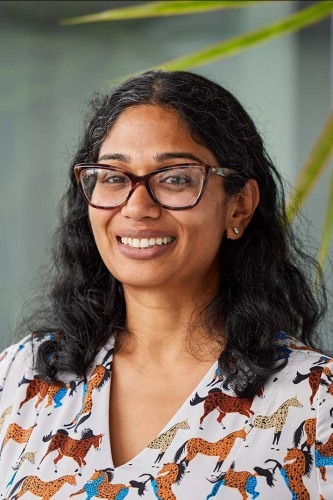
Sohini Ramachandran, Hermon C. Bumpus Professor of Biology and Data Science, Professor of Computer Science, and the Deputy Director of the Data Science Institute, Brown University
Senior Fellow VT2026-27
Advancing ancestry inference for studies integrating ancient & modern human genomes
My project aims to advance methods for ancestry inference by integrating ancient and modern human genomic data. Mixed-membership clustering algorithms, widely used in population genetics, face challenges when applied to datasets with temporal and sample-size imbalances, particularly involving ancient DNA. I will investigate the robustness of clustering outputs under varying conditions and develop improved strategies for aligning clustering results and inferring allele frequency trajectories over time, with applications to
studying genetic targets of selection following the Neolithic expansion. Additionally, I will study identity-by-descent (IBD) sharing in ancient genomes to understand recent genealogical connections and their implications for demographic inference, with applications to the Bantu expansion. Applying new approaches for studying IBD sharing from my group to ancient DNA will enable tracking of inherited segments and their ancestral origins, offering insights into historical mating patterns and population structure. As a Human Past Residential
Fellow, I will collaborate with colleagues at the Center to refine these tools, with particular focus on the Neolithic and Bantu expansions, ultimately enhancing our understanding of human evolutionary history.
The fellowship programme is an initiative by the Center for the Human Past, administered by the Swedish Collegium for Advanced Studies (SCAS). It is designed to foster a collaborative environment where early-stage and established scholars can converge across three disciplines, archaeology, population genetics and historical linguistics to explore the shared history of the world’s populations over the past 10,000 years.