

- This event has passed.
Mini-Seminar: Using the dog to date Torricelli languages with linguistic paleontology, with Erik Elgh
Abstract
The earliest archaeological dog remains in Melanesia found to date are from Babase Island, New Ireland, and are associated with the Early Lapita layers on the site, thus dating from ca. 3300-3000 BP (Summerhayes et al. 2019, see Manne et al. 2020 for an overview of dog remains in the area). The formation of the Lapita culture in the Bismarck Archipelago is in turn associated with the influx of Austronesians, more specifically speakers of Proto-Oceanic (Bellwood 2007:234, Pawley 2007 echoes this view). Thus, the introduction of the dog to Melanesia is likely tied to the arrival of the Austronesians to the area.
In the rest of the world, the presence of domesticated dogs is ubiquitous in the time depths we can hope to reach by linguistic reconstruction. By contrast, in Melanesia and thus New Guinea, the late date of first appearance makes the dog amenable to inclusion in analyses of linguistic paleontology. Linguistic paleontology involves correlating terms reconstructed for proto languages with definable archaeological phenomena, thus saying something about the time and place these proto languages were spoken. The foremost example is probable the so called ‘wheel line’, used to delimit the time of non-Anatolian Indo-European to after the invention of wheeled vehicles (see e.g. Anthony & Ringe 2015). Using the same method, if a word for ‘dog’ can be reconstructed for a Melanesian proto language, it shows that this proto-language must have split after ca. 3300 BP when the dog was introduced.
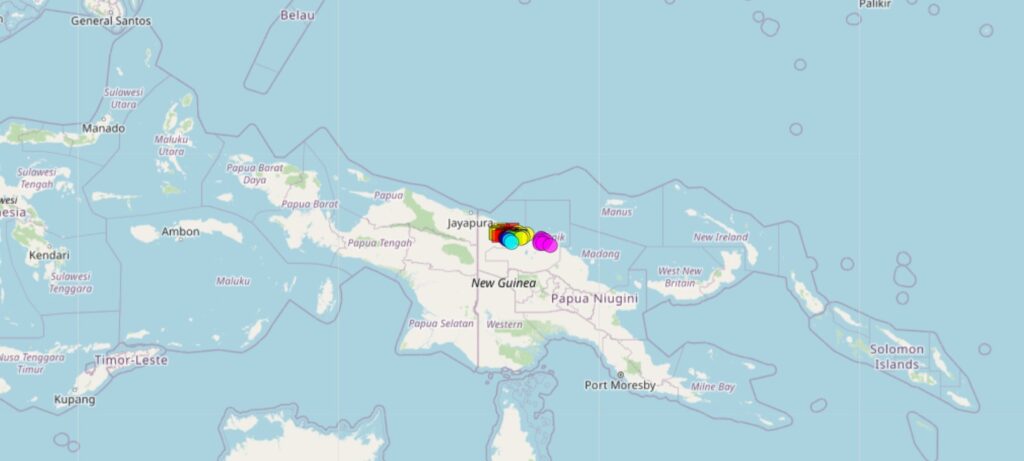
In this talk, I reconstruct a word for ‘dog’ for a large subgroup of Torricelli languages. Furthermore, I investigate words for ‘dog’ in nine other language families in the Sepik-Ramu basin and surrounding area in order to exclude large scale borrowing waves giving rise to the pattern seen in the relevant Torricelli languages. Disproving such waves, I show that the most recent common ancestor of a big proportion of Torricelli languages must have split after 3300 BP, rejecting earlier proposals stating that the current distribution of the family must be ‘several millenia’ or ‘six to five thousand years’ old (Foley 2018:296 and Swadling 1990, respectively).
I also discuss issues pertaining to Oceanic words for ‘dog’ in relation to those of languages in the Sepik-Ramu basin. For instance, the words in some Torricelli and many non-Torricelli languages are similar to those of the Schouten Linkage Oceanic languages, while at least one Schouten Linkage language, Arop-Sissano, seems to have borrowed from Olo, a local Torricelli language (as noted already by Hudson 1989). Additionally, I propose a historical scenario accounting for the scatter of forms that bear similarity to Proto-Austronesian *asu1 ‘dog’ (as reconstructed by Blust et al. 2023), reflexes of which are deemed to be absent in Proto-Oceanic (see e.g. Lynch 1991 and Pawley 2007).
Erik Elgh is an affiliated researcher in general linguistics at Uppsala University, and currently participates in the Postgraduate Linguistics Program, Faculty of Humanities, Udayana University, Indonesia